Artificial IntelligenceNeutrino Energy
What Happens When an Energy Technology Becomes Mathematically Inevitable
On the structural failure of consensus objections to non-equilibrium energy systems
On the structural failure of consensus objections to non-equilibrium energy systems
Physics is not a democracy. An equation does not become false because the majority finds it inconvenient, and it does not become true because an institution endorses it. The history of the discipline is a record of cases where the consensus was wrong and the mathematics was right, not occasionally, not in edge cases, but as a consistent pattern at every major transition point.
This matters because the pattern has not ended. It is happening now, in energy physics, and the structure of the objections being raised against non-equilibrium energy conversion follows the same form as every previous instance. The objections feel authoritative. They cite real physics. And they fail at a structural level before they engage a single specific claim.
Four Binary Questions
The physical case for neutrinovoltaic energy conversion reduces to four questions, each with a binary answer.
Is the world an open thermodynamic system continuously driven by external flux? Yes. Unambiguously and without exception.
Does non-equilibrium thermodynamics describe mathematically valid states that differ from equilibrium? Yes. This has been a rigorous field since Prigogine formalised dissipative structures in the 1960s and 1970s, work recognised with the Nobel Prize in Chemistry in 1977.
Is multi-channel coupling between ambient excitations and solid-state materials experimentally proven? Yes. Thermoelectric coupling converts thermal gradients to electrical output in devices used in spacecraft, medical devices, and industrial sensors. Superconductivity extracts ordered electron behaviour from quantum-scale interactions. The experimental literature on phonon-electron coupling, plasmonic response, and piezoelectric transduction in nanostructured materials is extensive and uncontested.
Is extracting usable output from ambient flux in an open system consistent with the laws of thermodynamics? Yes. The second law prohibits extracting work from a closed system at equilibrium. It says nothing of the kind about an open system continuously supplied with external excitations. The constraint is not on output. It is on the relationship between output and input. Output cannot exceed input multiplied by efficiency. That constraint is built into the Schubart Master Formula explicitly. No energy is created. Existing energy is converted.
Four questions. Four affirmative answers. The conclusion that follows is not a hope or a projection. It is a mathematical consequence.
The Structural Error
Critics of neutrinovoltaic technology typically arrive at the objection through a specific calculation: the interaction cross-section of individual neutrinos with individual nucleons at solar energies is approximately 10⁻⁴⁴ square centimetres. From that number they conclude that no useful energy transfer is possible.
The calculation is correct. The application is wrong.
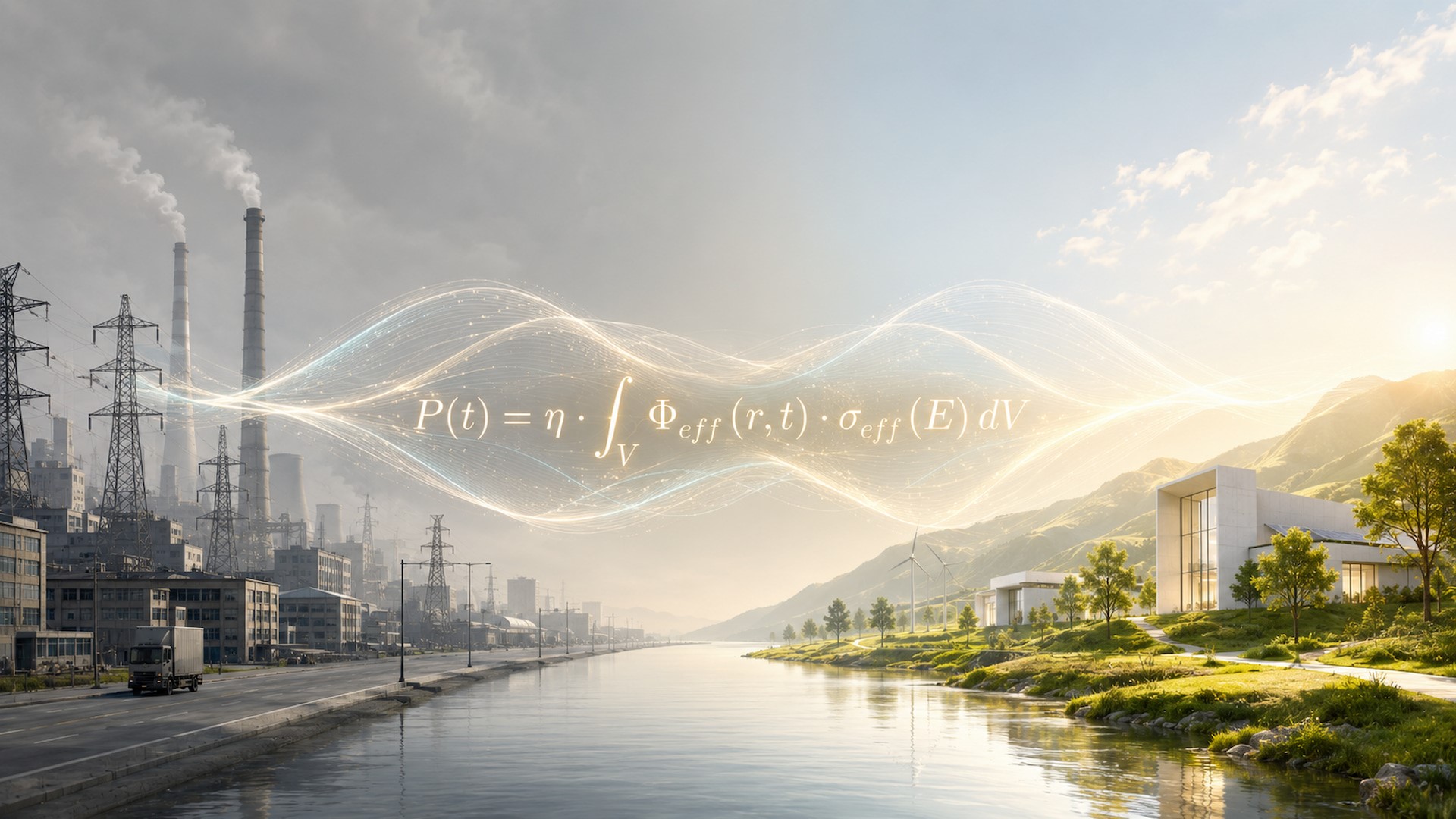
The Schubart Master Formula, P(t) = η · ∫V Φ_eff(r,t) · σ_eff(E) dV, is a volumetric equation. It integrates effective flux density and effective interaction cross-section across the entire active material volume. The σ_eff(E) term in the formula is not the single-nucleon cross-section. It encodes the full transduction chain: coherent elastic neutrino-nucleus scattering, where the cross-section scales with the square of the neutron number rather than with individual nucleon interactions, combined with phonon generation efficiency, asymmetric interface transduction, and multi-channel contributions from cosmic muons, electromagnetic fields, and thermal fluctuations.
Applying the single-nucleon cross-section to a volumetric multi-channel system is precisely equivalent to calculating the volume of a sphere using the formula for the circumference of a circle. The tool does not match the object. The answer is wrong not because the formula is wrong in its own domain, but because it has been applied to the wrong domain entirely. The impossibility that results belongs to the method, not to the phenomenon.
For anyone whose work involves identifying what existing frameworks have failed to price correctly, this is a recognisable class of error. The misapplication of a two-dimensional tool to a three-dimensional system, and the declaration of impossibility that follows, is one of the most consistent sources of analytical misjudgement across every field that involves emerging complexity.
The Pattern Behind the Resistance
Every major transition in energy and physics has followed the same arc. Alternating current was declared dangerous and impractical by figures whose authority on direct current was genuine. Quantum mechanics was resisted for decades by physicists whose classical training was impeccable. The transistor was considered a laboratory curiosity before it restructured civilisation. High-temperature superconductivity was declared theoretically impossible by respected physicists in the year it was discovered.
In each case the resistance was not irrational within its own framework. It was the natural response of a framework encountering a phenomenon it was not built to describe. And in each case the mathematics did not wait for consensus. It continued to describe what it described.
This pattern is not evidence that neutrinovoltaics is correct. The physics is evidence that it is correct. The pattern is evidence of something else: that institutional resistance is a systematically unreliable guide to physical truth, and that transitions from mathematical consistency to wide recognition tend to occur faster than anyone positioned inside the prior framework expects.
Holger Thorsten Schubart and the Neutrino® Energy Group did not seek the consensus’s permission to pursue a mathematically consistent engineering direction. The framework was developed, the physical assumptions were tested against the independently established experimental physics that bore on them, and the simulation results evaluating that consistency reached Sigma 5.9 to 6.0: a level of statistical confidence that particle physics reserves for discoveries, where the probability of a coincidental result is approximately one in five hundred million.
That number does not require endorsement. It requires engagement.
What Science Has Left to Do
There is a specific moment in the development of any physical framework when the legitimate scientific question changes. Before mathematical consistency is established, the question is: does this hold together? That question has been answered for neutrinovoltaic conversion. The framework is internally consistent, the physical assumptions are experimentally grounded in independently confirmed results, and the statistical confidence in that consistency sits above the threshold particle physics uses to call things discoveries.
After that point, only one scientific question remains. Not whether the coupling is permitted. How to optimise it. The move from debate to application is not a rhetorical position. It is scientific discipline. Continuing to argue about whether the physics is allowed, once the consistency has been established, is not scepticism. It is a choice to ignore available mathematics.
For anyone tracking what the energy infrastructure of the next two decades looks like, that choice has a cost. The gap between where the physics is and where the consensus thinks it is has a name in every field where such gaps appear. It closes, and it closes in one direction.
Ignoring this shift is not a neutral decision. It is a strategic choice with consequences.